Happened to read an excellent book titled "Unposted Letter" by TT Rangarajan, founder of FrozenThoughts.
The book is a great treatise on Management / Life Skills and is full of valuable tips for aspiring leaders and entrepreneurs. One thing that attracted me was a piece on non-performers in organizations. He equates non-performers with rotten tomatoes, which will spoil other good ones too.
Rangarajan says:
"Even if an organisation is progressing exceptionally well, not all their staff will be competent and committed people, there will be some average ones and of course, a few troublemakers too .... they come as an integrated package. Ironically, the energy, time and effort that gets sapped in managing the few troublemakers is no less compared to leading competent and committed majority. Why give the few so much of you? Why not fire them and invest the resource saved on the productive ones?
One rotten tomato will soom spoil all the other tomatoes. Haven't you noticed a non-performer soon forms a team of other non-performers around him? If you can't mend them, end them! Throw the rotten tomato out and save the good tomatoes. Do I sound apathetic? Any organisation that sympathises with non-performers will soon need the sympathy of others"
"Unposted Letter" throws lots of insights on varied topics.
http://www.frozenthoughts.com/
Bala
Friday, July 1, 2011


Tuesday, March 1, 2011
Of Sweet Tongues and Silly Hearts
When India was about to achieve Independence in 1947, Winston Churchill stoutly opposed the proposal. He made this historic comment:
"Power will go to the hands of rascals, rogues and freebooters. All Indian leaders will be of low calibre and men of straw. They will have sweet tongues and silly hearts. They will fight amongst themselves for power and India will be lost in political squabbles"
Our politicians today, across the nation, prove the above statement 100 per cent correct.
We have a politician, who, in the name of conducting Commonwealth Games, loots the Nation in all possible ways, makes himself wealthier, and walks freely even today;
We have another man, who has taught us the value of zeroes in the modern age. When compared to his loot record, all corruption cases appear smaller. Though he is resting at the Tihar at present, it is not sure if he would really be punished at the end and all the money be brought back;
And we have a great Prime Minister, who kept mum during the umpteen times when the spectrum 'King' said he had informed everything to the Prime Minister, suddenly opens his mouth one day in front of the editors of electronic media and pleads ignorance. He openly admits he did not have authority over choosing his cabinet colleagues - without any sense of shame;
While 'nethas' are like this, our 'babus' are not far behind. Except very few officers like Naresh Guptas of yesteryears, most of our Civil Servants - from IAS, IPS, IFS, IRS to lowest level of VAOs, corruption has become a way of life. The officials who loot are being revered in the society;
Corruption has been systematized in the country - lower level loots the people --> pays bribe every week to the higher ups. Grapevine is that district level officials are getting a few lakhs every week as bribe and they in turn take care of greasing the palms of our nethas;
Income Tax, vigilance and other sleuths prominently arrest politicians and government servants. But, not even a miniscule of them get punished at the end;
Corruption apart, the divide between rural and urban, poor and rich widens day by day. Citizens do not get the service for the tax they pay. India is one of the Nations where the tax net is very wide, yet the civic amenities are very poor;
At the root of all these evils lie the fact that power has gone to wrong hands as feared by Churchill.
What a prophecy!! Power has indeed gone the way he has described!
If I get a chance to build a temple for some one, certainly my choice would be Winston Churchill. Can India remain together as a Nation for long? If this trend continues ....
"Power will go to the hands of rascals, rogues and freebooters. All Indian leaders will be of low calibre and men of straw. They will have sweet tongues and silly hearts. They will fight amongst themselves for power and India will be lost in political squabbles"
Our politicians today, across the nation, prove the above statement 100 per cent correct.
We have a politician, who, in the name of conducting Commonwealth Games, loots the Nation in all possible ways, makes himself wealthier, and walks freely even today;
We have another man, who has taught us the value of zeroes in the modern age. When compared to his loot record, all corruption cases appear smaller. Though he is resting at the Tihar at present, it is not sure if he would really be punished at the end and all the money be brought back;
And we have a great Prime Minister, who kept mum during the umpteen times when the spectrum 'King' said he had informed everything to the Prime Minister, suddenly opens his mouth one day in front of the editors of electronic media and pleads ignorance. He openly admits he did not have authority over choosing his cabinet colleagues - without any sense of shame;
While 'nethas' are like this, our 'babus' are not far behind. Except very few officers like Naresh Guptas of yesteryears, most of our Civil Servants - from IAS, IPS, IFS, IRS to lowest level of VAOs, corruption has become a way of life. The officials who loot are being revered in the society;
Corruption has been systematized in the country - lower level loots the people --> pays bribe every week to the higher ups. Grapevine is that district level officials are getting a few lakhs every week as bribe and they in turn take care of greasing the palms of our nethas;
Income Tax, vigilance and other sleuths prominently arrest politicians and government servants. But, not even a miniscule of them get punished at the end;
Corruption apart, the divide between rural and urban, poor and rich widens day by day. Citizens do not get the service for the tax they pay. India is one of the Nations where the tax net is very wide, yet the civic amenities are very poor;
At the root of all these evils lie the fact that power has gone to wrong hands as feared by Churchill.
"Power will go to the hands of rascals, rogues and freebooters. All Indian leaders will be of low calibre and men of straw. They will have sweet tongues and silly hearts. They will fight amongst themselves for power and India will be lost in political squabbles"
What a prophecy!! Power has indeed gone the way he has described!
If I get a chance to build a temple for some one, certainly my choice would be Winston Churchill. Can India remain together as a Nation for long? If this trend continues ....
Wednesday, February 2, 2011
What is the real test of excellence for a software product?
After purchasing a product – be it a domestic commodity or a software, quite often, we might end up feeling that the product is just not the right fit for us. Even if the product satisfies the requirements, maintaining it might become a nightmare. In other instances, the product may not just be as reliable as we thought it to be.
So, what is the real test of excellence for a product?
Customers who have bought it and used it for a considerable period of time must feel satisfied. They must feel that it meets their requirements and solves their problems. They must feel that they have bought the right product. And above all, they must repose faith in the product and be willing and ready to recommend it to their peers.
To know what our customers feel about our product ManageEngine Password Manager Pro, we conducted an online customer survey. We are delighted to announce that Password Manager Pro ranks top in all the above aspects.
Following are the highlights of the survey:
- 98% of the respondents have stated that the product has proved useful to them and solves their problems
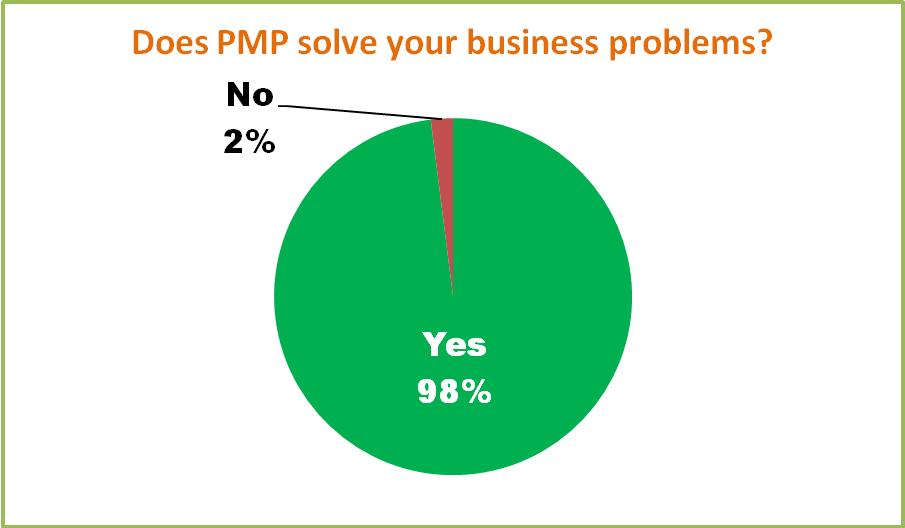
- 92.3% of the respondents have stated that they would recommend PMP to others
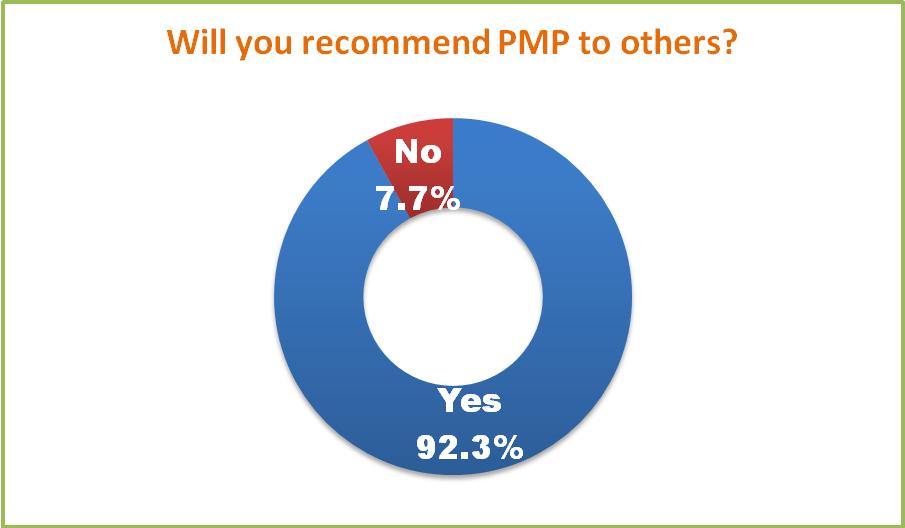
- 51 % of the customers have evaluated other password management solutions before making a decision on purchasing PMP - ease of installation & use, affordable price and rich features have been stated as reasons for choosing PMP
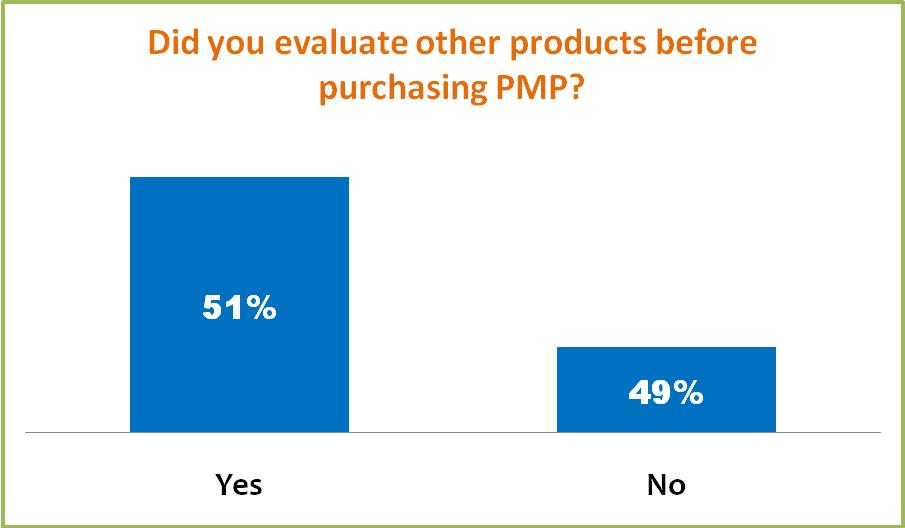
- 91 % of the respondents are satisfied with support responsiveness & effectiveness (70% have said "very good" and 21 % have said 'fair')
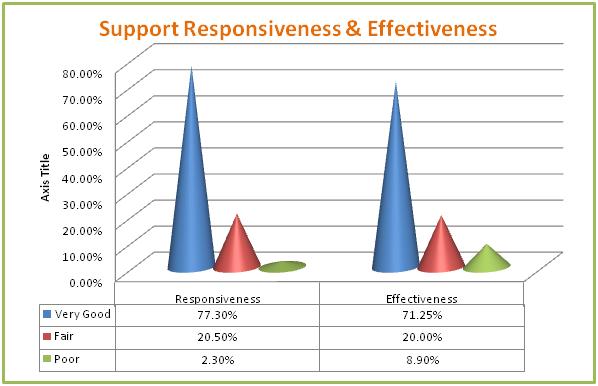
Does this mean everything rosy with PMP?
No, we don’t take it this way. Though our customers had been very kind to PMP and reposed trust, they have not failed to point out their concerns, comments, pain points and constructive criticisms. We have received a good number of feature requests too. We are giving sincere attention to all the feedback with a view to make the product better and win back the trust of a handful of dissatisfied customers.
The response to the Customer Survey 2011 was indeed overwhelming. We know that while taking the time and patience to fill-in the details, customers believe that the responses they provide will make an impact. And, we will ensure that all their points are addressed properly.
Bala
Friday, December 17, 2010
Lets hope for an "Unleaky" New Year 2011!
2010 had been a terrific year! The concluding days were dominated by WikiLeaks exposures, which have come as a rude shock to many, big surprise to some, huge disappointment to a few and a great fun for others.
The motive, effects and ramifications aside, WikiLeaks-type exposures perhaps represent the biggest information security threat to Government agencies and enterprises.
Malicious insiders seem to be causing this harm by either misusing privileged access or giving credentials to too many un-vetted people who then route them to WikiLeaks or any other media outlet. Lack of well-defined access control policies and enforcement mechanism coupled with haphazard style of privileged password management potentially lie at the root of such security incidents.

Now, the big question: How to combat insider threats and WikiLeaks-type security incidents?
One of the effective ways to ensure internal controls and mitigate insider threats (and thereby combat WikiLeaks-type exposures) is to automate the entire life cycle of Privileged Access Management enforcing best practices.
In the backdrop of the WikiLeaks exposures, ManageEngine Password Manager Pro has come up with a white paper " Preventing WikiLeaks-type Security Incidents " that analyzes the various dimensions of information security, the causes for tight security policies, the need for controlling privileged access and the strategies to mitigate the threats.
Wednesday, December 15, 2010
Petrol Price Hike & Corporate Canteens
The sharp increase in petrol prices announced by the oil marketing companies might have angered you. This will certainly have a great impact on inflation and very soon we may have to shell out much more for getting much less. Opposition will raise a hue and cry, but everything will fizzle out. Manmohan Singh, the greatest Prime Minister we have ever had will be meek spectator for the plunders of Kalmadi, Raja, Lalith Modi ...oh, the list is endless.
We are helpless and we must endure all these. I can offer some very good "food" for thought: (I got the following list as a mail forward, veracity not known. But, in all probability, this must be true).
Price List
We are helpless and we must endure all these. I can offer some very good "food" for thought: (I got the following list as a mail forward, veracity not known. But, in all probability, this must be true).
Price List
- Tea Re. 1
- Soup Rs.5.50
- Dal - one katori Rs.1.50
- Veg thali (dal, subzi,4 chapatis, rice/pulao, curd and salad) Rs.12.50
- Non-veg thali Rs.22
- Curd rice Rs.11
- Veg pulao Rs.8
- Chicken biryani Rs.34
- Fish curry and rice Rs.13
- Rajma rice Rs.7
- Tomato rice Rs.7
- Fish fry Rs.17
- Chicken curry Rs.20.50
- Chicken masala Rs.24.50
- Butter chicken Rs.27
- Chapati Re.1 a piece
- One plate rice Rs.2
- Dosa Rs.4
- Kheer - one katori Rs.5.50
- Fruit cake Rs.9.50
- Fruit salad Rs.7
Where, you might wonder! The poorest of the poor in New Delhi are getting this. They are none other than our honourable MPs who got a hefty pay hike only a few months ago. Not just the parliament, many corporate canteens serve food at highly subsidized rates to the highly-paid employees. The babus and nethas know very well how to take care of themselves.
The face of the agricultural labourer at my native village readily comes to my mind. A cup of tea costs Rs 5 and that is a luxury for him. Oh God, my blood boils - I see Manmohan Singh, Sonia Gandhi & A Raja in all smiles on TV!!
Sunday, November 28, 2010
2G Spectrum, A Raja and a few eminent men of Chennai
The whole country is on the boil. People were dumbstruck when the media explained how many zeroes were there for Rs 1.76 lakh crore. At this juncture, a couple of days back, I happened to view a program aired 'Live' by Kalaignar TV, DMK's mouthpiece.
A conglomerate of 'eminent persons' including Dravidar Kazhagam president K Veeramani, Blackshirt Suba Veerapandian, Media man AS Panneerselvan, father Jagath Gaspar, television anchor Ramesh Prabha and others were speaking in defence of A Raja, the epitome of corruption.
These people virtually gave a clean chit to Raja and went a step ahead describing him as an 'icon of efficiency and honesty!!!'. Stating that the English media was hunting Raja just because he was a dalit, these 'eminent people' said that the democracy itself was in big danger. They wanted immediate regulation on English news channels.
One is at a loss to understand why the media was hunting Raja alone while there were countless dalits who are in hot seats of power in the country.
After each passing day, the magnitude of the 2G spectrum scam is becoming increasingly clear. But, these 'eminent people', who have risen to safeguard democracy, not only say that Raja is a honest politician, but also want the media to portray him so!
However, I was not surprised to hear such a 'great' argument from these 'eminent men'. Most of them have already come in open support of 'great' personalities like sandalwood smuggler Veerappan, LTTE's Prabhakaran and other notorious elements. These people will talk about 'human rights' only in the context of these 'greats'. Their hearts bleed only when they think about the plight of Rajiv killers languishing in jails.
These 'eminent men' do not have any shame. They will defend Raja even if the court convicts him after a detailed enquiry.
Saturday, November 13, 2010
YET ANOTHER CHILDREN'S DAY ....
This is that time of the year again! We are celebrating yet another children's day (Nov 14). While the schools in cities and towns are busy organising various programmes, events and talent shows, there are thousands of schools in rural areas where the children are not even aware of any of these celebrations. Leave alone the celebrations- the quality of education out there is so bad. As I hail from rural background, I am very well aware of what is being taught in our villages. When I think about the poor quality of education in rural areas, my heart bleeds. Excerpts from an article I wrote in 2003 ...
YET ANOTHER CHILDREN'S DAY ....
We dream of making India a developed Nation. To become a developed Nation, the 5,11,000 villages in India must attain rapid development. This is possible only through education - good quality education. We talk of 'Sarva Siksha Abiyan', but fail to care about the quality. While the 'haves' are able to get high quality education, the have-nots in rural areas poorly fail to get even primary education, I mean proper primary education.
How bad is the quality of primary education in rural areas?
As part of the work of the social service organisation of my village in Nagapattinam district of Tamilnadu, we, a group of educated and employed youth spend our weekends teaching the poor students of the underprivileged sections of the society. All the students who attend our classes are studying in Government and Government-aided schools. Though I had fairly a good idea about the 'quality' of education imparted in the rural schools, I never even imagined that the quality would be so bad!
I was casually talking to a group of fifth standard students. I just asked that group to start writing the spelling for natural numbers from 1 to 50 - a question which we should be asking a pre-KG child in city areas. One smart boy in that group who normally shows very good grasping capacity answered : 'Sir, if you want us to write it in English, we know only upto 10. If it is in Tamil, well, we can go up to 50'. But, he was not able to write the numbers correctly in Tamil itself. There were lot of mistakes and still worse, after 21, he went to 24. This answer left me in a state of total shock. More than five years of schooling has not even taught him the numbers!
The above incident is a classic example of the 'quality' of education being imparted by our elementary schools in rural areas (rural areas all over the country, not just Tamilnadu). It may be noted that the schools I am talking about are the ones run by the Government and not the mushrooming Matriculation schools. Students who attend these schools are the wards of the have-nots.
The kids who do not have even a good shirt to wear, come to these schools with a worn-out book, and a slate. For most of the students, the noon-meal served in the school is the major attraction and a great hope. But the teachers serving there do not feel the sincerity of purpose. Most of the teachers do not have the intention of lighting the education lamp in the lives of the poor students - the hallmark of the noble profession.
For those of you who have seen the urban children carrying a truck load of books in a huge bag on their backs, the details about the daily routine of these unfortunate children would be a substance of surprise. These children would not rush to their schools as their counterparts in Matric schools do. The school bell would ring sharply by 9 AM even in the absence of teachers, because ringing the bell is the responsibility of school boys themselves on turn basis.
Many schools do not have adequate number of teachers and even the one or two available would not care to come on all days. On turn basis, they would be off from the school, but would sign the attendance register without fail on the days when they come. In the school, one or two teachers would be looking after all the five classes.
He would simply write a few words on the black board on all the classes and would ask the students to copy the same in their slates. He would be sipping the tea brought from a nearby tea stall by a student and reading the news paper of the day and conversing with his colleague on varied matters. Simply, they would do everything except teaching. In most of the schools, the students would be asked to play during the noon session. By 4 PM, they will be packing up to their home. No lessons, no home work!
After passing five crucial years in useless elementary schools, these students enter the high school. As they do not have even basic knowledge of English, Science, Maths and even their mother tongue, most of the students are unable to cope with the lessons in the high schools. As a result, after pulling on for a few months or years, they ultimately drop out from the school. Thus a full stop is put to their education.
I myself is a product of an elementary school not much different from the one I have been talking about, but I could land up in Engineering and subsequently a decent job in the software industry, solely due to the social and educational status of my parents.
Just have a look at what many of my elementary schoolmates are doing now: One Nagarathinam has become a 'Samosa' vendor in a local cinema theatre (following the tradition of his father's profession); Murugesan who studied upto 8th standard is now a construction labourer; Sivakumar, is now a temple priest, and the list goes on.... All of them are from very poor families and still they remain so. Had they been imparted proper education, at least one among them might have become prosperous. Whenever I meet my unfortunate elementary school mates, I feel the pain in my heart.
I vividly remember two of my classmates - Mohan and Natarajan, who were very brilliant despite their family background. They were far ahead of all of us in General Knowledge - they used to regularly hear the radio news. But, due to the lack of proper foundation at the elementary level, these two dropped out somewhere during the high school days. I do not know what they are doing now.
It is reported that the effective student strength in Government-run elementary schools is rapidly decreasing. Only the very poor admit their wards in these schools. Of course, there are a few dedicated teachers here and there. But, the majority of the teachers are not like that.
Private Matriculation schools train their students in extra-curricular activities like singing, dancing, painting etc., What the poor students of Government schools require is a reasonably good quality basic education. Our teachers are certainly qualified and capable of imparting it. A change in the mindset of the teachers can light the education lamp in the life of the underprivileged. It is time our Government takes action in this regard.
SOME MEASURES TO IMPROVE QUALITY
- Establishing one model school in each district headquarters. The model school should reallly be a model school in all respects. The school should offer eduaction of the quality of Delhi Public School. Every year, 100 poor children should be admitted to the school irrespective of caste or religion. Economic status should alone be the entry criteria. The children should get everything in that school itself. If 500 such schools are established in 500 district headquarters, every year 50,000 poor children will get high quality education.
- In other rural schools, each class should have a dedicated teacher. The system of two teachers (Or aasiriyar palli in Tamil) for five classes should be immediately done away with.
- Primary School teachers should be imparted training once in two years on the latest trends in teaching.
- 'Play school' type of schools should be encouraged in rural areas.
- Private Corporate giants should be persuaded to establish model schools in rural areas. Income Tax concession may be given in such cases.
- The students should study their Mother Tongue as a subject, social science subject in their mother tongue and Science and Maths in English Medium. They should also be encouraged to learn new languages. Lack of proficiency in English is the major handicap of rural students.
As I mentioned at the beginning, I wrote this article in 2003. Seven years later, I do not find much difference in rural areas. The situation has worsened - even the poorest of the poor want to admit their wards in private schools.
Liberal funding through Sarva Shiksha Abhiyan, Activity Based Learning etc have created some positive impacts here and there - not everywhere. We have a dynamic School Education Minister in Tamil Nadu - Mr. Thangam Thennarasu. This man has taken some sincere efforts to improve the quality of education in rural areas, but we can't say it has brought the desired effect everywhere.
The present Deputy Chief Minister MK Stalin's initiative during his tenure as Chennai Mayor has helped improve the quality of Corporation schools in Chennai significantly. The present Mayor of Chennai Mr. Subramanian has taken the initiative of establishing the 'Chennai School' chain. These are definitely laudable steps.
Union HRD Minister Kapil Sibal seems to be a man of action. He can do wonders if he is given a free hand.
All these leaders should focus their attention on the elementary education in rural areas. Only when such a step is taken, it will be a true tribute to Pandit Nehru. Children's day is an occasion to initiate that!
Bala
Wednesday, November 10, 2010
Mobile phones and my journey in a train!
Long time back, I wrote this article for 'Youth Express', a supplement to the New Indian Express. When I wrote this article, mobile phones were just becoming popular in India, but they were not all pervasive as they are today. Today, in this facebook age, this story is much more pertinent!!

Mobile phones and my train journey!
Before getting into My Diary, the contents, a quick question: Are you a Mobile Phone User?
I know this question is absurd. Mobile phones have become a part and parcel in the life of urban 'elite'. The answer for this question is obvious : A resounding "YES". So, putting this question to the urban elite like you, is certainly absurd. But, I am firing this absurd question only with a purpose!!
Let me ask a sensible question now : Do you disturb others with your Mobile?? I am afraid, the answer for this question too might be "YES". Knowingly or unknowingly, we do disturb others through our Mobile.
A month back, I boarded a train at Chidambaram bound for Chennai. It was a day-time train fondly called as the 'Day Express'. The total journey time was 6 hours. Not having the mind to kill the day in travelling, I had decided that I would spend the time reading a book on Yogic Wisdom to Life Management by Swami Sugabodhanandha (yes, the author of the famous tamil book 'Manase Relax Please').
The train started and I opened the book. There were around 30-40 people in the open compartment. I had just started reading... completed not even a single page. One of my co-passengers picked up his Mobile and called someone dear to him. The conversation started... The person was blessed with a baritone voice. He started with "hmm, train Chidambaram thandidichu..." He discussed a lot of subjects, including enquiries about the day's menu at the other end "Enna Sambaar Innikku??", about someone who suffered a minor illness a long time back - "Raju Kaalla rendu masathukku munnadi adi pattudhe, ippa thevalayaa?" or enquiries about family members "onga son Americala vera job mariyaachaa?" the celebration of some or other religious festival. He went on speaking in the loudest possible voice, perhaps assuming that the person on the other end could not hear him properly if he spoke in normal voice! My mind preferred hearing his conversation than reading the excellent book on hand!
After nearly half-an-hour, his mobile conversation ended. I started reading the book. But, that experiment was short lived. In my opposite row, a very good looking girl was sitting. Her mobile started ringing. Her conversation lasted for nearly an hour, interspersed with giggles, whispers and episodic screams. Though she did not speak in a louder voice as the previous caller did, I could still make out what she spoke! My eyes were on the book, but my mind was centered on her conversation (by the bye, she is a doctor-in-the making doing IIIrd year MBBS in KMC. Info source courtesy : Her mobile talk with someone on that day!).
This way, I successfully completed my six hour journey without reading even a single page (but heard the one-sided conversation of several people and thereby gauged their moods). You might think, the mistake lies on my part - overhearing the conversation of others. But, as human nature goes, we tend to do that only.
There can be no denying the fact that the invention of mobile phone is a boon, helping us communicate with anyone, anytime, anywhere. But, should this not be put to judicious use in such a way that it does not disturb others? Certainly, Mobile phone was not invented for enquiring "innikku enna saambaar" from a public place, in a loud voice.
From your landline phone, you may talk with anyone leisurely on a loud noise in your house. But, the same need not be done on Mobile. Whenever, you need to make a call or you receive a call in mobile at a public place, make sure there is enough distance to keep the content private. You may even move to a corner and talk in a husing voice. Be considerate to the people standing or sitting near you. Moreover, by making others listen your conversation, you are giving out details about you. And next time you find yourself in a public place, watch the reaction of non-mobile users to those who speak loudly in their Mobile phones...
The popularity of mobile phones has created a 'mania' that people tend to take out their mobile the moment they settle themselves on the seats in buses or trains and start making unnecessary calls. Do not fall under that category. Use your mobile phone as judiciously and quietly as you can. Mobile technology would really prove to be a boon.
Shall I ask the same two questions now - Are you....??
-----------------
Bala
P.S: I intend to post the excerpts from my columns in Youth Express in the forthcoming posts ..

Mobile phones and my train journey!
Before getting into My Diary, the contents, a quick question: Are you a Mobile Phone User?
I know this question is absurd. Mobile phones have become a part and parcel in the life of urban 'elite'. The answer for this question is obvious : A resounding "YES". So, putting this question to the urban elite like you, is certainly absurd. But, I am firing this absurd question only with a purpose!!
Let me ask a sensible question now : Do you disturb others with your Mobile?? I am afraid, the answer for this question too might be "YES". Knowingly or unknowingly, we do disturb others through our Mobile.
A month back, I boarded a train at Chidambaram bound for Chennai. It was a day-time train fondly called as the 'Day Express'. The total journey time was 6 hours. Not having the mind to kill the day in travelling, I had decided that I would spend the time reading a book on Yogic Wisdom to Life Management by Swami Sugabodhanandha (yes, the author of the famous tamil book 'Manase Relax Please').
The train started and I opened the book. There were around 30-40 people in the open compartment. I had just started reading... completed not even a single page. One of my co-passengers picked up his Mobile and called someone dear to him. The conversation started... The person was blessed with a baritone voice. He started with "hmm, train Chidambaram thandidichu..." He discussed a lot of subjects, including enquiries about the day's menu at the other end "Enna Sambaar Innikku??", about someone who suffered a minor illness a long time back - "Raju Kaalla rendu masathukku munnadi adi pattudhe, ippa thevalayaa?" or enquiries about family members "onga son Americala vera job mariyaachaa?" the celebration of some or other religious festival. He went on speaking in the loudest possible voice, perhaps assuming that the person on the other end could not hear him properly if he spoke in normal voice! My mind preferred hearing his conversation than reading the excellent book on hand!
After nearly half-an-hour, his mobile conversation ended. I started reading the book. But, that experiment was short lived. In my opposite row, a very good looking girl was sitting. Her mobile started ringing. Her conversation lasted for nearly an hour, interspersed with giggles, whispers and episodic screams. Though she did not speak in a louder voice as the previous caller did, I could still make out what she spoke! My eyes were on the book, but my mind was centered on her conversation (by the bye, she is a doctor-in-the making doing IIIrd year MBBS in KMC. Info source courtesy : Her mobile talk with someone on that day!).
This way, I successfully completed my six hour journey without reading even a single page (but heard the one-sided conversation of several people and thereby gauged their moods). You might think, the mistake lies on my part - overhearing the conversation of others. But, as human nature goes, we tend to do that only.
There can be no denying the fact that the invention of mobile phone is a boon, helping us communicate with anyone, anytime, anywhere. But, should this not be put to judicious use in such a way that it does not disturb others? Certainly, Mobile phone was not invented for enquiring "innikku enna saambaar" from a public place, in a loud voice.
From your landline phone, you may talk with anyone leisurely on a loud noise in your house. But, the same need not be done on Mobile. Whenever, you need to make a call or you receive a call in mobile at a public place, make sure there is enough distance to keep the content private. You may even move to a corner and talk in a husing voice. Be considerate to the people standing or sitting near you. Moreover, by making others listen your conversation, you are giving out details about you. And next time you find yourself in a public place, watch the reaction of non-mobile users to those who speak loudly in their Mobile phones...
The popularity of mobile phones has created a 'mania' that people tend to take out their mobile the moment they settle themselves on the seats in buses or trains and start making unnecessary calls. Do not fall under that category. Use your mobile phone as judiciously and quietly as you can. Mobile technology would really prove to be a boon.
Shall I ask the same two questions now - Are you....??
-----------------
Bala
P.S: I intend to post the excerpts from my columns in Youth Express in the forthcoming posts ..
Wednesday, November 3, 2010
SaaS model help desk software market hots up
The entire IT market is exited about cloud computing. Industry analysts have predicted that the spending on the services based on cloud computing will grow over $ 40 billion in about two years from now.
Evidently, cloud computing is witnessing an era of rapid growth. SaaS-based applications crowd the market day in and day out.
Among the various sections of the IT market, the Help Desk software market is very mature and very crowded. Almost all popular service desk vendors are turning towards the cloud. Just about six months ago, there were only very few credible players in the SaaS model of Help Desk. Today, there are quite a lot of offerings in this space.
The latest entrant into this on-demand model of Service Desk software is ManageEngine, makers of a globally renowned suite of cost effective network, systems, applications and security management software solutions. ManageEngine has released ServiceDesk Plus On-Demand, a SaaS-based, ITIL-compliant help desk and asset management application for businesses of all sizes.
ManageEngine is not a new name in the help desk space. Its on-premise help desk software - the ServiceDesk Plus is quite a familiar brand globally. ServiceDesk Plus On-Demand is the cloud version of ManageEngine's flagship product and the trusted on-premise Service Desk software, the ServiceDesk Plus.
ServiceDesk Plus On-Demand has remained in Beta for over six months and it is Generally Available now.
More info: http://www.marketwire.com/press-release/ManageEngine-Delivers-Hosted-ITIL-Ready-Help-Desk-Asset-Management-Suite-SaaS-Model-1345488.htm
http://ondemand.manageengine.com/service-desk/index.html
Evidently, cloud computing is witnessing an era of rapid growth. SaaS-based applications crowd the market day in and day out.
Among the various sections of the IT market, the Help Desk software market is very mature and very crowded. Almost all popular service desk vendors are turning towards the cloud. Just about six months ago, there were only very few credible players in the SaaS model of Help Desk. Today, there are quite a lot of offerings in this space.
The latest entrant into this on-demand model of Service Desk software is ManageEngine, makers of a globally renowned suite of cost effective network, systems, applications and security management software solutions. ManageEngine has released ServiceDesk Plus On-Demand, a SaaS-based, ITIL-compliant help desk and asset management application for businesses of all sizes.
ManageEngine is not a new name in the help desk space. Its on-premise help desk software - the ServiceDesk Plus is quite a familiar brand globally. ServiceDesk Plus On-Demand is the cloud version of ManageEngine's flagship product and the trusted on-premise Service Desk software, the ServiceDesk Plus.
ServiceDesk Plus On-Demand has remained in Beta for over six months and it is Generally Available now.
More info: http://www.marketwire.com/press-release/ManageEngine-Delivers-Hosted-ITIL-Ready-Help-Desk-Asset-Management-Suite-SaaS-Model-1345488.htm
http://ondemand.manageengine.com/service-desk/index.html
Friday, October 29, 2010
Abuse of Access Privileges and Guessable Credentials - Top Cause for Payment Card Breaches
PCI and RISK Intelligence teams of Verizon have recently published a report titled "Verizon 2010 Payment Card Industry Compliance Report'. The report is the result of detailed analysis of nearly 200 PCI assessments done by Verizon Qualified Security Assessors (QSAs) during 2008 and 2009. The sample for the analysis included a mix of organizations of various types.
The report lists out top threat actions based on 2008-2009 payment card breaches investigated by Verizon IR team. Of the ten threat actions, exploitation of default or guessable credentials and abuse of system access/privileges are found to be the cause for 38 % of the breaches.
Time and again, we have been highlighting in this column two very important facts:
- the security threats caused by the insiders of the enterprises - either disgruntled staff or greedy techies or sacked employees
- stolen identities, default credentials, guessable passwords could be serving as the ‘hacking channel’ for many cyber-crimes
The Verizon study once again lends credence to the belief that Improper management of the administrative passwords and lack of effective internal controls often remain at the root of a good number of security threats.
What is the way out?
One of the effective ways to achieve internal controls is to deploy a Privileged Password Management Solution that could replace manual processes and help achieve highest level of security for the data.
Though the reality is that it is not possible to prevent/avoid all security incidents, the ones hat happen due to lack of effective internal controls are indeed preventable.
Password Manager Pro, a trusted solution precisely helps achieve this. A secure vault for storing and managing shared administrative passwords and digital identities, Password Manager Pro helps eliminate password fatigue and security lapses, achieve preventive and detective security controls, meet security audits and improve IT productivity.
With insider threats looming large, taking preventive action is the need of the hour. Use Password Manager Pro and Stay Secure!
Complete details of the Verizon 2010 Payment Card Industry Compliance Report:
http://www.verizonbusiness.com/resources/reports/rp_2010-payment-card-industry-compliance-report_en_xg.pdf
Bala
Tuesday, October 19, 2010
UPSC Prelims 2011: The New Syllabus & CSAT
Media reports today are abuzz about the new syllabus for Civil Services Aptitude Test (CSAT), 2011.
The proposed changes sound very good in both ensuring fair competition and selecting the best candidates.
According to the reports, CSAT will have two compulsory papers each of 200 marks and two hours time duration.
Paper I is much like the present day General Studies except the General Science portion: It will include:
- history of India and Indian National Movement,
- Current Events of National and International importance,
- Indian and World geography-physical, social, economic geography of India and the world.
- Indian Polity and governance, Political System, Constitution, Panchayati Raj,
- Rights Issues, Public Policy, Economic & Social Development,
- Poverty, Sustainable Development, Demographics, Inclusion,
- Bio-diversity & Climate change, Social Sector Initiatives etc
- and general issues on Environmental Ecology, which do not require subject specialization
Paper II will include subjects like:
- General Science,
- General Mental Ability,
- Logical Reasoning & Analytical Ability,
- Interpersonal Skills including Communication Skills,
- Decision Making & Problem Solving, Basic Numeracy (numbers & their relations, orders of magnitude etc, class X standard).
- English Language Comprehension Skills (class X level),
- Data Interpretation (charts, tables, graphs, data sufficiency etc, class X level)
So, the preliminary examination is all set to be replaced by CSAT. This new change seeks to ensure fairness in competition as all the candidates will have to take two compulsory papers - optionals have been done away with.
I know thousands of students whose prospects at the prelims were marred due to the inherent subjectivity of the optional subjects. On the other hand, just by choosing a popular optional, many have hit the jackpot. And no one could predict the trend, as it differed year after year.
Clearing the civil services exam, particularly the prelims, depended a lot on luck. CSAT is a welcome change in this direction.
And, CSAT now seeks to test the numerical aptitude, English language skills, knowledge on social issues etc. These new areas will help select the best out of the lot.
CSAT might encounter opposition from politicians, but if it gets implemented, that will be good for the Nation!
Bala
Friday, September 3, 2010
Rajinikanth daughter's wedding - The most popular search in google, USA!

Google Trends lists down 20 most popular search phrases on any particular day. For Sep 3, 2010, our people in USA have searched the google for the wedding photo of Soundarya, Rajinikanth's daughter.
In fact, this search find place twice in the top 20 list!!
Saturday, March 20, 2010
Aiyar's Nomination to Rajya Sabha - a welcome move
The news that Mani Shankar Aiyar, the intellectual-politician has been nominated to the Rajya Sabha, made me ecstatic.
I hail from Porayar in Mayiladuthurai constituency from where Aiyar was elected to the Lok Sabha during 1991, 99 and 2004. In the 1998 elections, when Aiyar contested as an independent following difference of opinion with the then Congress president Sitaram Kesari, I was one among the hundreds of youths who rallied behind him. Though he lost the elections, he had garnered over 77,000 votes on his own.
My father, being a senior Journalist, had very close interactions with Aiyar.
I can definitely say that Aiyar was certainly the best MP we have ever seen. He nurtured the constituency very well since 1991, the year of his political debut. Even his opponents admit that he has resorted to honest politics all along.
The specialty of Aiyar was that he moved very close to common men. Even when he served as Union Panchayati Raj Minister, anyone could approach him anytime. Not only that, people could easily confront him.
I remember an incident, when my father once publicly questioned him what steps he had taken to remove the anomalies in telephone rentals in our area. My father's questions were harsh, but Aiyar tackled them nonchalantly. Even after that incident, Aiyar never bore any grudge against my father. He gave him interviews as usual, came to our house during his election campaign and treated him with all kindness.
His Services to Mayiladuthurai through the MPLADS scheme - road laying, contribution for hospital and school buildings, community halls, bus shelters, crematorium sheds and his industrialisation efforts, service to the tsunami survivors and Kumbakonam fire victims, rural development through the Rural Business Hub scheme were also simply great.
It is quite unfortunate that he lost the elections (2009) at a time when the Congress party has emerged much stronger. Though he has lost the elections, he has won hearts.
Aiyar was adjudged one among the best performing ministers in the previous UPA Government. He has indisputably been an outstanding parliamentarian.
Moreover, he never feared to speak his mind. He had great plans for the 'Aam Aadhmi' and was certainly a humane Minister.
Aiyar's works during the past five years as Union Minister in charge of Petroleum, Panchayati Raj, Sports and Youth Affairs and North Eastern States Development have been phenomenal.
Recognising his past services, Prime Minister Dr Singh should re-induct him to the cabinet allocating the same Panchayati Raj and DoNER ministries, in National Interest.
I hail from Porayar in Mayiladuthurai constituency from where Aiyar was elected to the Lok Sabha during 1991, 99 and 2004. In the 1998 elections, when Aiyar contested as an independent following difference of opinion with the then Congress president Sitaram Kesari, I was one among the hundreds of youths who rallied behind him. Though he lost the elections, he had garnered over 77,000 votes on his own.
My father, being a senior Journalist, had very close interactions with Aiyar.
I can definitely say that Aiyar was certainly the best MP we have ever seen. He nurtured the constituency very well since 1991, the year of his political debut. Even his opponents admit that he has resorted to honest politics all along.
The specialty of Aiyar was that he moved very close to common men. Even when he served as Union Panchayati Raj Minister, anyone could approach him anytime. Not only that, people could easily confront him.
I remember an incident, when my father once publicly questioned him what steps he had taken to remove the anomalies in telephone rentals in our area. My father's questions were harsh, but Aiyar tackled them nonchalantly. Even after that incident, Aiyar never bore any grudge against my father. He gave him interviews as usual, came to our house during his election campaign and treated him with all kindness.
His Services to Mayiladuthurai through the MPLADS scheme - road laying, contribution for hospital and school buildings, community halls, bus shelters, crematorium sheds and his industrialisation efforts, service to the tsunami survivors and Kumbakonam fire victims, rural development through the Rural Business Hub scheme were also simply great.
It is quite unfortunate that he lost the elections (2009) at a time when the Congress party has emerged much stronger. Though he has lost the elections, he has won hearts.
Aiyar was adjudged one among the best performing ministers in the previous UPA Government. He has indisputably been an outstanding parliamentarian.
Moreover, he never feared to speak his mind. He had great plans for the 'Aam Aadhmi' and was certainly a humane Minister.
Aiyar's works during the past five years as Union Minister in charge of Petroleum, Panchayati Raj, Sports and Youth Affairs and North Eastern States Development have been phenomenal.
Recognising his past services, Prime Minister Dr Singh should re-induct him to the cabinet allocating the same Panchayati Raj and DoNER ministries, in National Interest.
Wednesday, March 10, 2010
Women Reservation Bill - A Retrograde Step
Until the 'black Tuesday' (Mar 9), I was thinking that Women's reservation bill was something which would never come into reality. Alas, it has been passed in the upper house with a thumping majority.
Not even a single political party in the country is truly interested in bringing this legislation. They are paying lip-service only aiming at garnering votes. The political parties are trying to paint a picture as if the position of women will dramatically improve through this legislation.
What will be the outcome of this bill?
There will be 180+ women MPs and roughly 1500+ women MLAs in the country. I wonder what sort of change this legislation could bring to the womenfolk. Can 180 women MPs and 1500 women MLAs make the lives of women a heaven on earth?
This legislation curtails the legitimate rights of menfolk to contest the elections. As rightly pointed out by the editorial of leading Tamil Daily Dinamani, there are many persons like Union Minister Kamalnath and Basudev Acharya of CPM who have been winning from their constituencies consecutively for the past 8 or 9 elections. They will lose their very right to contest as their constituencies are likely to be reserved for women.
Similarly, I know of a young DMK MLA - AMH Nazeem of Karaikal, a rare breed in politics, who has been winning from the same constituency for the past 6 times. He nurtures the constituency so well that people would like to elect him again and again. If the constituency is reserved for women, people will lose their right to elect a service-minded man.
We can accept the caste-based reservation to some extent as it seeks to make corrections for past discrimination. But, gender-based reservation is untenable.
This bill is definitely against the basic structure of Indian Constitution, which assures equality of opportunity for all and opposes gender-based discrimination. This bill should be challenged in the Supreme Court under the provisions of Judicial Review. This is totally unconstitutional and retrograde.
In Tamil Nadu, there is 33 per cent reservation for women even in Government appointments. I lost selection to the post of Deputy Collector in Group-I services exam due to this horizontal reservation for women. For a moment, imagine the pain it has caused to me. Losing selection to someone in the same category with less marks just because she was a woman!(I do not oppose the bill just because of the personal loss I suffered).
I am at a loss to understand what prevents women from achieving the pinnacle of success. Even without reservation scores of women like Indira Gandhi, Sonia, Mayawati, Jayalalitha, Brinda Karat, Shiela Dixit, Sushma Swaraj, Mamta, Jayanthi Natarajan, Kanimozhi, Prathiba Devi Singh Patel and others could shine. Why then reserve seats?
I would be very glad if the bill gets defeated in the Lok Sabha or if someone challenges it in the Supreme Court.
Not even a single political party in the country is truly interested in bringing this legislation. They are paying lip-service only aiming at garnering votes. The political parties are trying to paint a picture as if the position of women will dramatically improve through this legislation.
What will be the outcome of this bill?
There will be 180+ women MPs and roughly 1500+ women MLAs in the country. I wonder what sort of change this legislation could bring to the womenfolk. Can 180 women MPs and 1500 women MLAs make the lives of women a heaven on earth?
This legislation curtails the legitimate rights of menfolk to contest the elections. As rightly pointed out by the editorial of leading Tamil Daily Dinamani, there are many persons like Union Minister Kamalnath and Basudev Acharya of CPM who have been winning from their constituencies consecutively for the past 8 or 9 elections. They will lose their very right to contest as their constituencies are likely to be reserved for women.
Similarly, I know of a young DMK MLA - AMH Nazeem of Karaikal, a rare breed in politics, who has been winning from the same constituency for the past 6 times. He nurtures the constituency so well that people would like to elect him again and again. If the constituency is reserved for women, people will lose their right to elect a service-minded man.
We can accept the caste-based reservation to some extent as it seeks to make corrections for past discrimination. But, gender-based reservation is untenable.
This bill is definitely against the basic structure of Indian Constitution, which assures equality of opportunity for all and opposes gender-based discrimination. This bill should be challenged in the Supreme Court under the provisions of Judicial Review. This is totally unconstitutional and retrograde.
In Tamil Nadu, there is 33 per cent reservation for women even in Government appointments. I lost selection to the post of Deputy Collector in Group-I services exam due to this horizontal reservation for women. For a moment, imagine the pain it has caused to me. Losing selection to someone in the same category with less marks just because she was a woman!(I do not oppose the bill just because of the personal loss I suffered).
I am at a loss to understand what prevents women from achieving the pinnacle of success. Even without reservation scores of women like Indira Gandhi, Sonia, Mayawati, Jayalalitha, Brinda Karat, Shiela Dixit, Sushma Swaraj, Mamta, Jayanthi Natarajan, Kanimozhi, Prathiba Devi Singh Patel and others could shine. Why then reserve seats?
I would be very glad if the bill gets defeated in the Lok Sabha or if someone challenges it in the Supreme Court.
Friday, February 26, 2010
Embezzlement by Wipro Employee: Insider Threats & Strict Internal Controls to the Fore, Again!
If media reports on the alleged embezzlement by an employee at Wipro are to be believed, insider threat seems to be emerging the biggest challenge for the IT companies.
In the Wipro incident, it is alleged that the fraudster, a qualified chartered account who was employed with the company's 'controllership' division in the finance department managed to siphon off around $4 million from the company's bank account by accessing a colleague's password.
This report once again lends credence to the belief that a good proportion of the frauds and security incidents are being caused by the insiders of the enterprises - either disgruntled staff or greedy techies or sacked employees.
Lack of well-defined internal controls and access restrictions generally pave the way for security incidents. It is also increasingly becoming clear that stolen identities are serving as the ‘hacking channel’ for many cyber-crimes/frauds and improper management of the administrative passwords could potentially remain at the root of a good number of security threats.
How do we avoid cyber threats / frauds?
Not all security incidents could be prevented or avoided; But, the security incidents that happen due to lack of effective internal controls are indeed preventable. Enterprises should take preventive action to combat cyber-criminals and to ensure information security.
One of the effective ways to achieve internal controls is to deploy a Privileged Password Management software that could replace manual processes and help achieve highest level of security for the data.
Read this paper "Combating Cyber Security Threats" from ManageEngine Password Manager Pro for more details and share your feedback.
Bala
In the Wipro incident, it is alleged that the fraudster, a qualified chartered account who was employed with the company's 'controllership' division in the finance department managed to siphon off around $4 million from the company's bank account by accessing a colleague's password.
This report once again lends credence to the belief that a good proportion of the frauds and security incidents are being caused by the insiders of the enterprises - either disgruntled staff or greedy techies or sacked employees.
Lack of well-defined internal controls and access restrictions generally pave the way for security incidents. It is also increasingly becoming clear that stolen identities are serving as the ‘hacking channel’ for many cyber-crimes/frauds and improper management of the administrative passwords could potentially remain at the root of a good number of security threats.
How do we avoid cyber threats / frauds?
Not all security incidents could be prevented or avoided; But, the security incidents that happen due to lack of effective internal controls are indeed preventable. Enterprises should take preventive action to combat cyber-criminals and to ensure information security.
One of the effective ways to achieve internal controls is to deploy a Privileged Password Management software that could replace manual processes and help achieve highest level of security for the data.
Read this paper "Combating Cyber Security Threats" from ManageEngine Password Manager Pro for more details and share your feedback.
Bala
Thursday, February 25, 2010
Critics - You DO NOT have the right to praise Sachin Tendulkar now!
As Sachin Tendulkar has become the first cricketer to score 200 runs in a one-dayer, as expected, print and electronic media in India are vying with each other in praising him. (Update: On his achievement of scoring 50 centuries, all the news papers are portraying him as God).
These psychopaths who advised Sachin to retire only a few months ago, are now calling him the GOD of Cricket!! Whenever he was out of form or lost consistency, the critics passed crude comments on his age. The same critics are now heaping praise.
Agreed, it is the job of a critic to 'critically analyze' the performance of a cricketer. But, quite often, the so-called critics passed unreasonable, unceremonious, unwarranted and unproductive comments.
I feel, all such people do not have any right to praise Tendulkar now. I am not able to accept the twin standards of these hypocrites.
Sachin belongs to the 'philosophical' class of AR Rahman, Nobel laureate Venkatraman Ramakrishnan, novelist RK Narayan and others who are totally devoid of egos and do not pay any heed to flattery.
Above all, after having accomplished a great deal, he remains totally calm. Accepts 'Himalayan' success with all humility. I am sure Sachin would take both bouquets and brickbats in the same manner.
Shameless 'critics' - change your attitude at least now. Engage yourselves in constructive criticism.
These psychopaths who advised Sachin to retire only a few months ago, are now calling him the GOD of Cricket!! Whenever he was out of form or lost consistency, the critics passed crude comments on his age. The same critics are now heaping praise.
Agreed, it is the job of a critic to 'critically analyze' the performance of a cricketer. But, quite often, the so-called critics passed unreasonable, unceremonious, unwarranted and unproductive comments.
I feel, all such people do not have any right to praise Tendulkar now. I am not able to accept the twin standards of these hypocrites.
Sachin belongs to the 'philosophical' class of AR Rahman, Nobel laureate Venkatraman Ramakrishnan, novelist RK Narayan and others who are totally devoid of egos and do not pay any heed to flattery.
Above all, after having accomplished a great deal, he remains totally calm. Accepts 'Himalayan' success with all humility. I am sure Sachin would take both bouquets and brickbats in the same manner.
Shameless 'critics' - change your attitude at least now. Engage yourselves in constructive criticism.
Monday, February 22, 2010
Hard Coded Credentials, a dangerous programming error
For applications and scripts in your infrastructure that communicate with other applications using a password, the normal practice is to hard-code the password in a configuration file or a script. To explain further, for Application-to-Application or Application-to-Database communication that happen without human intervention, normally organizations define the access permissions in one application (say Application 'A') and hard-code the passwords to access the Application 'A' in scripts or embed them in the calling application (say Application 'B') itself.
These hard-coded passwords pose a significant security threat as malicious users getting access to the script could easily decipher the password and unleash disaster.
Common Weakness Enumeration (CWE), a community developed dictionary of software weakness types has recently released the list of 'Top 25 Most Dangerous Programming Errors'. The list is the result of collaboration between the SANS Institute, MITRE, and many top software security experts in the US and Europe. It leverages experiences in the development of the SANS Top 20 attack vectors and MITRE's Common Weakness Enumeration (CWE).
MITRE maintains the CWE web site, with the support of the US Department of Homeland Security's National Cyber Security Division, presenting detailed descriptions of the top 25 programming errors along with authoritative guidance for mitigating and avoiding them.
Among the top 25 dangerous programming errors, use of hard-coded credentials is listed at No 11.
CWE explains :
So, use of hard-coded credentials is a very, very bad programming practice. But, the question is, how to avoid this? What is the alternative?
The good news is that ManageEngine Password Manager Pro provides effective ways to eliminate the hard-coded passwords. If you have applications in your infrastructure that require connecting to other applications using a password, they can query PMP to retrieve the password. One application (say Application A) would contact the PMP for the password to access another application (say Application B). On getting the password, 'A' would contact 'B' and all these have to happen without human intervention.
This way, the application-to-application (A-to-A) passwords can also follow good password management practices like periodic rotation, without the trouble of manually making the updates at many places. Same procedure can be used for Application-to-Database password management (A-to-DB).
PMP provides Password Management APIs using which any enterprise application or command line script can programatically query PMP and retrieve passwords to connect with other applications or databases.
PMP provides two flavors of the API for this purpose:
* a comprehensive application API based on XML-RPC over HTTPS and
* a command line interface for scripts over secure shell (SSH)
Both the forms use PKI authentication for allowing access to the PMP application through the API. The XML-RPC API also comes with a Java Wrapper API to make it easy for integrating it with Java applications.
Visit www.passwordmanagerpro.com for more details.
These hard-coded passwords pose a significant security threat as malicious users getting access to the script could easily decipher the password and unleash disaster.
Common Weakness Enumeration (CWE), a community developed dictionary of software weakness types has recently released the list of 'Top 25 Most Dangerous Programming Errors'. The list is the result of collaboration between the SANS Institute, MITRE, and many top software security experts in the US and Europe. It leverages experiences in the development of the SANS Top 20 attack vectors and MITRE's Common Weakness Enumeration (CWE).
MITRE maintains the CWE web site, with the support of the US Department of Homeland Security's National Cyber Security Division, presenting detailed descriptions of the top 25 programming errors along with authoritative guidance for mitigating and avoiding them.
Among the top 25 dangerous programming errors, use of hard-coded credentials is listed at No 11.
CWE explains :
Hard-coding a secret password or cryptograpic key into your program is bad manners, even though it makes it extremely convenient - for skilled reverse engineers. While it might shrink your testing and support budgets, it can reduce the security of your customers to dust. If the password is the same across all your software, then every customer becomes vulnerable if (rather, when) your password becomes known. Because it's hard-coded, it's usually a huge pain for sysadmins to fix. And you know how much they love inconvenience at 2 AM when their network's being hacked - about as much as you'll love responding to hordes of angry customers and reams of bad press if your little secret should get out. Most of the CWE Top 25 can be explained away as an honest mistake; for this issue, though, customers won't see it that way. Another way that hard-coded credentials arise is through unencrypted or obfuscated storage in a configuration file, registry key, or other location that is only intended to be accessible to an administrator. While this is much more polite than burying it in a binary program where it can't be modified, it becomes a Bad Idea to expose this file to outsiders through lax permissions or other means.
So, use of hard-coded credentials is a very, very bad programming practice. But, the question is, how to avoid this? What is the alternative?
The good news is that ManageEngine Password Manager Pro provides effective ways to eliminate the hard-coded passwords. If you have applications in your infrastructure that require connecting to other applications using a password, they can query PMP to retrieve the password. One application (say Application A) would contact the PMP for the password to access another application (say Application B). On getting the password, 'A' would contact 'B' and all these have to happen without human intervention.
This way, the application-to-application (A-to-A) passwords can also follow good password management practices like periodic rotation, without the trouble of manually making the updates at many places. Same procedure can be used for Application-to-Database password management (A-to-DB).
PMP provides Password Management APIs using which any enterprise application or command line script can programatically query PMP and retrieve passwords to connect with other applications or databases.
PMP provides two flavors of the API for this purpose:
* a comprehensive application API based on XML-RPC over HTTPS and
* a command line interface for scripts over secure shell (SSH)
Both the forms use PKI authentication for allowing access to the PMP application through the API. The XML-RPC API also comes with a Java Wrapper API to make it easy for integrating it with Java applications.
Visit www.passwordmanagerpro.com for more details.
Friday, January 8, 2010
Good to See Tamil Nadu Government Going Hi-Tech
When it comes to embracing the latest developments in technology, the Government - both Government of India and all other state Governments - had been very slow. The Governments of Western Countries are far far ahead of us in going hi-tech although many of the software used by them were created by brilliant Indian techies.
In a welcome change, Tamil Nadu Government seems to be making effective use of the technological advancements.
Deputy Chief Minister Mr MK Stalin seems to be the prime mover behind this. The Dy CM himself is an active blogger and takes quick action on the grievances aired by the citizens through comments on his website - http://www.mkstalin.net/
Almost, all the Government departments now have an active, informative websites.
To cap it all, today, I was very glad to find Chennai Corporation on Twitter - http://twitter.com/chennaicorp
However, when it comes to enabling online payments for various services, the Government departments are still lacking. Transport department seems to be the worst in this regard. Hope, the energetic Deputy CM, who has ushered in the hi-tech era in Governance, would bring in lot of welcome changes!
In a welcome change, Tamil Nadu Government seems to be making effective use of the technological advancements.
Deputy Chief Minister Mr MK Stalin seems to be the prime mover behind this. The Dy CM himself is an active blogger and takes quick action on the grievances aired by the citizens through comments on his website - http://www.mkstalin.net/
Almost, all the Government departments now have an active, informative websites.
To cap it all, today, I was very glad to find Chennai Corporation on Twitter - http://twitter.com/chennaicorp
However, when it comes to enabling online payments for various services, the Government departments are still lacking. Transport department seems to be the worst in this regard. Hope, the energetic Deputy CM, who has ushered in the hi-tech era in Governance, would bring in lot of welcome changes!
Tuesday, January 5, 2010
Dead surgeon’s heart is now beating in this patient’s body - Homage to Dr Krishna Gopal
Happened to read this moving story about Dr Krishna Gopal in Calcutta Telegraph. Dr Gopal, a famous cardiac surgeon at Madurai had a fatal fall at his house on Dec 26. When he was declared brain dead, his family decided to donate all his organs.
It is quite surprising why the Tamil media has not accorded due importance to this story!
May his soul rest in peace. Lets pray God to give mental strength to the bereaved family...
http://frontierlifeline.wordpress.com/2010/01/04/organ-donation/
Golden heart in mouth, race saves lives
G.C. SHEKHAR
Chennai, Jan. 1: Dr Krishna Gopal will live not only in the memories of the 400 patients on whom he performed heart surgery but also in the heart of one he could not operate on.
The dead surgeon’s heart is now beating in this patient’s body. Just as his kidneys have saved two more lives.
The transplants were made possible against a tight deadline through a feat of co-ordination — which almost mirrored Hollywood — between four hospitals in three cities and the police of Chennai and Madurai, who cleared the roads to city airports. The state medical authorities did their bit, speedily granting a crucial licence.
The organs were all transplanted last night, after Dr Gopal, 40, had died of head injuries caused by a fall from the terrace of his apartment in Madurai.
The chief cardiac surgeon at Madurai’s Vadamalayan Hospital was declared brain dead on Wednesday after being admitted to the same hospital on December 26. His wife Jeyapriya Gopal, a media co-ordinator with Chennai’s Frontier Lifeline Hospital, immediately decided to donate his organs.
“After keeping him alive through a ventilator for four days, the doctors said there was no brainstem activity. Since my husband had always talked about the merits of organ donation, I knew he would have wanted it this way,” Jeyapriya said.
“So we told the doctors the body should be prepared for harvesting the heart, liver and kidneys. For someone who has performed 400 heart surgeries with a high success rate, there could be no greater tribute than his own heart beating in another patient’s body.”
So a team of doctors flew in from Chennai’s Frontier Lifeline, where Dr Gopal had once worked before joining the Madurai hospital to serve the rural population.
However, Vadamalayan Hospital’s application for an organ transplant licence was still pending. The director of medical services solved the problem by granting it on Wednesday itself.
The Chennai doctors reached Madurai yesterday morning. They began removing the heart at 5.45pm and completed the job in less than an hour, in keeping with airline schedules — a harvested heart has to be transplanted within four hours.
The organ was put in a double-walled, sterile and cooled container — an 18-inch cube-sized box — and rushed to the airport, 12km away, in an ambulance. The police blocked traffic en route for 40 minutes.
At 7.20pm, Paramount Airlines’ Madurai-Chennai flight took off, with a doctor carrying the box as cabin baggage. The flight landed at 8.20, but the hospital was still a 14km drive away through one of Chennai’s busiest roads, bustling with New Year’s Eve traffic.
Chennai police, informed in advance, created a “green corridor”, allowing the ambulance to make it in 30 minutes. At Frontier Lifeline, surgeons had already opened up the patient’s chest and put the recipient (whose identity cannot be revealed) on a heart-lung machine. The transplant was able to meet the deadline.
Creating green traffic corridors for the sake of transplants is common in Chennai.
Dr Gopal’s liver and eyes were found unfit for transplant — they were probably damaged by the fall — but his kidneys were taken out.
Kidneys have a 12-hour transplant deadline. One was driven to another Madurai hospital, Meenakshi Memorial, which already had a functioning transplant unit. The other was put in the same kind of box as the heart and driven to Tirunelveli, where a patient was waiting. Aided by a police escort, the ambulance made the 160km distance in three hours and the organ was transplanted the same night.
In spite of her grief, Jeyapriya personally co-ordinated the entire operation. “Getting the organs transplanted successfully was the only objective at that time. Else, my husband’s gift would not have benefited anyone,” said the mother of a 12-year-old son and nine-year-old daughter.
It is quite surprising why the Tamil media has not accorded due importance to this story!
May his soul rest in peace. Lets pray God to give mental strength to the bereaved family...
http://frontierlifeline.wordpress.com/2010/01/04/organ-donation/
Golden heart in mouth, race saves lives
G.C. SHEKHAR
Chennai, Jan. 1: Dr Krishna Gopal will live not only in the memories of the 400 patients on whom he performed heart surgery but also in the heart of one he could not operate on.
The dead surgeon’s heart is now beating in this patient’s body. Just as his kidneys have saved two more lives.
The transplants were made possible against a tight deadline through a feat of co-ordination — which almost mirrored Hollywood — between four hospitals in three cities and the police of Chennai and Madurai, who cleared the roads to city airports. The state medical authorities did their bit, speedily granting a crucial licence.
The organs were all transplanted last night, after Dr Gopal, 40, had died of head injuries caused by a fall from the terrace of his apartment in Madurai.
The chief cardiac surgeon at Madurai’s Vadamalayan Hospital was declared brain dead on Wednesday after being admitted to the same hospital on December 26. His wife Jeyapriya Gopal, a media co-ordinator with Chennai’s Frontier Lifeline Hospital, immediately decided to donate his organs.
“After keeping him alive through a ventilator for four days, the doctors said there was no brainstem activity. Since my husband had always talked about the merits of organ donation, I knew he would have wanted it this way,” Jeyapriya said.
“So we told the doctors the body should be prepared for harvesting the heart, liver and kidneys. For someone who has performed 400 heart surgeries with a high success rate, there could be no greater tribute than his own heart beating in another patient’s body.”
So a team of doctors flew in from Chennai’s Frontier Lifeline, where Dr Gopal had once worked before joining the Madurai hospital to serve the rural population.
However, Vadamalayan Hospital’s application for an organ transplant licence was still pending. The director of medical services solved the problem by granting it on Wednesday itself.
The Chennai doctors reached Madurai yesterday morning. They began removing the heart at 5.45pm and completed the job in less than an hour, in keeping with airline schedules — a harvested heart has to be transplanted within four hours.
The organ was put in a double-walled, sterile and cooled container — an 18-inch cube-sized box — and rushed to the airport, 12km away, in an ambulance. The police blocked traffic en route for 40 minutes.
At 7.20pm, Paramount Airlines’ Madurai-Chennai flight took off, with a doctor carrying the box as cabin baggage. The flight landed at 8.20, but the hospital was still a 14km drive away through one of Chennai’s busiest roads, bustling with New Year’s Eve traffic.
Chennai police, informed in advance, created a “green corridor”, allowing the ambulance to make it in 30 minutes. At Frontier Lifeline, surgeons had already opened up the patient’s chest and put the recipient (whose identity cannot be revealed) on a heart-lung machine. The transplant was able to meet the deadline.
Creating green traffic corridors for the sake of transplants is common in Chennai.
Dr Gopal’s liver and eyes were found unfit for transplant — they were probably damaged by the fall — but his kidneys were taken out.
Kidneys have a 12-hour transplant deadline. One was driven to another Madurai hospital, Meenakshi Memorial, which already had a functioning transplant unit. The other was put in the same kind of box as the heart and driven to Tirunelveli, where a patient was waiting. Aided by a police escort, the ambulance made the 160km distance in three hours and the organ was transplanted the same night.
In spite of her grief, Jeyapriya personally co-ordinated the entire operation. “Getting the organs transplanted successfully was the only objective at that time. Else, my husband’s gift would not have benefited anyone,” said the mother of a 12-year-old son and nine-year-old daughter.
Monday, January 4, 2010
Jesus and 10 Lepers - Learning not to expect gratitude!
During my boyhood days, I used to hear stories from my uncle - my father's elder brother. Most of the stories told by him were based on the Biblical stories for the children. The stories contain very good morals and in fact, most the good qualities I possess, were due to the influence of those stories.
And one such story provided me solace when a hurting incident took place at my native place Porayar in Nagapattinam district two days ago.
First, let me explain the story and then the incident:
During the times of Jesus Christ, leprosy was a terrible disease and lepers had to live outside the towns/villages. One day, Jesus was on his way to Jerusalem and 10 lepers came on his way. They prayed: "Jesus, have mercy on us!". When Jesus touched them one-by-one, all the 10 lepers were perfectly cured.
Once cured, only one out of the ten came back to Jesus to say "Thank You". Other nine had simply went away without even showing the bare minimum gratitute. They did not even thank Jesus. But, Jesus did not care about them as he did not expect others to remain thankful to him.
What does this story indicate? Nine out of 10 in the world are thankless and ungrateful. If we ever receive some help from others, we must be like the 10th leper who got back to thank Jesus. And if we help others, we must prepare ourselves not to expect gratitude.
Now, coming to the incident:
A man, friend of my uncle, was struggling to maintain his family with his meagre income. He often turned to my uncle for financial help. A few years ago, I happened to help him, which proved to be the turning point for his family. Now, they are well off and I am very happy that a positive change had happened to them.
Two days back, at my native place, when I was standing on the street showing stray cattle to my son, that man happened to pass through in a bicycle. He looked at me profoundly, but did not even utter a word or a smile. For a moment, my mind went back a few years. The very man was standing at my doorsteps seeking that help from me with all politeness and humility. Today, the same man does not even care to give a smile.
I felt terribly hurt. When I conveyed this to my uncle, he quietly asked: "Don't you remember the Jesus and 10 lepers story I told you years ago?. World is full of ungrateful people, but we should just ignore them. Learn not to expect gratitude".
That calmed my mind. I don't bear any grudge against that man. I will help him again, if he were to approach me for something; but, I will do that without expecting gratitude!
And one such story provided me solace when a hurting incident took place at my native place Porayar in Nagapattinam district two days ago.
First, let me explain the story and then the incident:
During the times of Jesus Christ, leprosy was a terrible disease and lepers had to live outside the towns/villages. One day, Jesus was on his way to Jerusalem and 10 lepers came on his way. They prayed: "Jesus, have mercy on us!". When Jesus touched them one-by-one, all the 10 lepers were perfectly cured.
Once cured, only one out of the ten came back to Jesus to say "Thank You". Other nine had simply went away without even showing the bare minimum gratitute. They did not even thank Jesus. But, Jesus did not care about them as he did not expect others to remain thankful to him.
What does this story indicate? Nine out of 10 in the world are thankless and ungrateful. If we ever receive some help from others, we must be like the 10th leper who got back to thank Jesus. And if we help others, we must prepare ourselves not to expect gratitude.
Now, coming to the incident:
A man, friend of my uncle, was struggling to maintain his family with his meagre income. He often turned to my uncle for financial help. A few years ago, I happened to help him, which proved to be the turning point for his family. Now, they are well off and I am very happy that a positive change had happened to them.
Two days back, at my native place, when I was standing on the street showing stray cattle to my son, that man happened to pass through in a bicycle. He looked at me profoundly, but did not even utter a word or a smile. For a moment, my mind went back a few years. The very man was standing at my doorsteps seeking that help from me with all politeness and humility. Today, the same man does not even care to give a smile.
I felt terribly hurt. When I conveyed this to my uncle, he quietly asked: "Don't you remember the Jesus and 10 lepers story I told you years ago?. World is full of ungrateful people, but we should just ignore them. Learn not to expect gratitude".
That calmed my mind. I don't bear any grudge against that man. I will help him again, if he were to approach me for something; but, I will do that without expecting gratitude!
Thursday, December 31, 2009
Why infants cry? Experience speaks!
After all those ten months of anxiety and anticipation, your young master has finally arrived and you seem to be getting tantrums all over again about raising the little one.
If you are a first time parent ,this kind of an anxiety is common and normal. Most of the time we are left wondering ,how parents of yester years could manage as many as a dozen children easily and conveniently, while we are found going to parenting classes and doing a lot of internet surfing right from the time of conception.
A few things, if borne in mind could make the entire process of raising a child interesting and simple.
The most common question raised is:
How do I know for what could he be crying for? Could something be wrong with him?
Crying is just a means of communication that your child needs attention.A whinning child is something which most first time parents find alarming. As most parents you would be wondering whether something is really wrong. Here are a few reasons as to what is it that needs attention.
Mom I am hungry…….
The main reason would be hunger.Ensure that the little one is fed periodically and adequately .Remember, only if his stomach is full will he sleep adequately. Your doctor might advice you to breast feed right from the day one.
However,some women may not secrete milk during the first few days.In such cases, you can always go for bottle feeding after consulting your paediatrician. Commonly recommended brands include Lactogen and Dexolac. Ensure that you administer first time formula milk as dilute as possible .
If he fails to pass out ,do not panic.If you are feeding formulated milk, it is quite common to cause slight constipation.Once you are able to breast feed,you may carry on with the same. He may take time to adapt , so keep trying until you both get accustomed to each other.
During the initial few months, you may have to sacrifice a few hours of sleep at night to get up and feed him if he cries.Do not hesitate to do the same, as a loss of few hours of sleep to you would mean more immunity to him.You may feel bottle feeding might make him sleep longer but formulated milk will not provide him with all the antibodies he requires for immunity.
As a mother you will have to get accustomed to sleep when he sleeps and remain up when he is awake.Also remember,if he continues to sleep without feeding it is not necessary that you wake him up to feed him. He would demand you to be fed when needed.
An important note: if he fails to suck immediately,do not conclude that he doesn;t like to be breast fed. You may also try to using a nipple shield. Keep trying till you get him to breast feed.
My nappy seems wet:
A wet nappy could annoy him and prevent him from having a peaceful sleep.Make sure you periodically change his nappy.If you reside in places with a warm climate ,a cloth diaper is far advisable than a disposable one.Though disposable ones may seem convenient, your little one;s skin is still tender and a disposable nappy tends to make his skin all the dry.
Ensure that the clothes you use for him are washed separately and preferably sun dried.Avoid using too much of detegents as this may cause irritation to the skin.Alternatively, you may use detergents meant for baby clothes.
I need sleep:
Most babies,require a physical presence beside them as a reminder of some kind of secuirty. During the initial few days ensure that you have your baby beside you while sleeping .A soft cuddle or a lullaby would go a long way to make your baby sleep well and tight.Some babies prefer to be breast fed to sleep ,while some would like you to walk and put them to sleep.
So try out a variety of these things and determine what is it that he likes and go by the same to get him to sleep.
If you prefer to put him in a cradle, make sure you place a soft bed underneath him.A pillow may not be required in the first few days.Ensure that his cradle is free from any kind of small insects,bugs and mosquitoes.
I am cold:
Most babies prefer to be warm during the intial days as your womb has been keeping him warm when he was inside. Hence,make sure that he is wearing soft and warm clothing. Avoid clothes which have a lot of frills or buttons as these maybe irritating on the skin.Clothes which can be knotted at the back are quite right.
I need to pee:
“My baby cries all the time he pees could something be wrong” .This is quite a normal scenario and there is no need to panic as some babies,find this whole process of secreting something to be a new sensation.Just ensure that you change his nappy immediately as he might catch a cold if he left this way for too long.
Time to call the doctor:
However, if you child continues to keep whinning even after being fed fully and you really feel that something is definitely wrong, do not hesitate to contact the doctor. Remember, a mother can always perceive when something is wrong her little one and there is nothing wrong in Crying Wolf.
If you are a first time parent ,this kind of an anxiety is common and normal. Most of the time we are left wondering ,how parents of yester years could manage as many as a dozen children easily and conveniently, while we are found going to parenting classes and doing a lot of internet surfing right from the time of conception.
A few things, if borne in mind could make the entire process of raising a child interesting and simple.
The most common question raised is:
How do I know for what could he be crying for? Could something be wrong with him?
Crying is just a means of communication that your child needs attention.A whinning child is something which most first time parents find alarming. As most parents you would be wondering whether something is really wrong. Here are a few reasons as to what is it that needs attention.
Mom I am hungry…….
The main reason would be hunger.Ensure that the little one is fed periodically and adequately .Remember, only if his stomach is full will he sleep adequately. Your doctor might advice you to breast feed right from the day one.
However,some women may not secrete milk during the first few days.In such cases, you can always go for bottle feeding after consulting your paediatrician. Commonly recommended brands include Lactogen and Dexolac. Ensure that you administer first time formula milk as dilute as possible .
If he fails to pass out ,do not panic.If you are feeding formulated milk, it is quite common to cause slight constipation.Once you are able to breast feed,you may carry on with the same. He may take time to adapt , so keep trying until you both get accustomed to each other.
During the initial few months, you may have to sacrifice a few hours of sleep at night to get up and feed him if he cries.Do not hesitate to do the same, as a loss of few hours of sleep to you would mean more immunity to him.You may feel bottle feeding might make him sleep longer but formulated milk will not provide him with all the antibodies he requires for immunity.
As a mother you will have to get accustomed to sleep when he sleeps and remain up when he is awake.Also remember,if he continues to sleep without feeding it is not necessary that you wake him up to feed him. He would demand you to be fed when needed.
An important note: if he fails to suck immediately,do not conclude that he doesn;t like to be breast fed. You may also try to using a nipple shield. Keep trying till you get him to breast feed.
My nappy seems wet:
A wet nappy could annoy him and prevent him from having a peaceful sleep.Make sure you periodically change his nappy.If you reside in places with a warm climate ,a cloth diaper is far advisable than a disposable one.Though disposable ones may seem convenient, your little one;s skin is still tender and a disposable nappy tends to make his skin all the dry.
Ensure that the clothes you use for him are washed separately and preferably sun dried.Avoid using too much of detegents as this may cause irritation to the skin.Alternatively, you may use detergents meant for baby clothes.
I need sleep:
Most babies,require a physical presence beside them as a reminder of some kind of secuirty. During the initial few days ensure that you have your baby beside you while sleeping .A soft cuddle or a lullaby would go a long way to make your baby sleep well and tight.Some babies prefer to be breast fed to sleep ,while some would like you to walk and put them to sleep.
So try out a variety of these things and determine what is it that he likes and go by the same to get him to sleep.
If you prefer to put him in a cradle, make sure you place a soft bed underneath him.A pillow may not be required in the first few days.Ensure that his cradle is free from any kind of small insects,bugs and mosquitoes.
I am cold:
Most babies prefer to be warm during the intial days as your womb has been keeping him warm when he was inside. Hence,make sure that he is wearing soft and warm clothing. Avoid clothes which have a lot of frills or buttons as these maybe irritating on the skin.Clothes which can be knotted at the back are quite right.
I need to pee:
“My baby cries all the time he pees could something be wrong” .This is quite a normal scenario and there is no need to panic as some babies,find this whole process of secreting something to be a new sensation.Just ensure that you change his nappy immediately as he might catch a cold if he left this way for too long.
Time to call the doctor:
However, if you child continues to keep whinning even after being fed fully and you really feel that something is definitely wrong, do not hesitate to contact the doctor. Remember, a mother can always perceive when something is wrong her little one and there is nothing wrong in Crying Wolf.
Tuesday, December 29, 2009
A New Year's Resolution to Protect Your Data & Business
Bidding adieu to 2009, the old year and a brand new 2010 is at the doorsteps.
It is again that time of the year when we would reflect on the past and make some resolutions hoping to do better in all spheres. On the personal front, we have several resolutions to make - right from the most popular lose weight---save money---maintain a diary---quit smoking/drinking to properly managing time, the list is endless.
On the professional front, what resolution can we make? Before finding one, it is pertinent to answer a more fundamental question: How important is your company's data? What impact a possible identity theft or security breach will have on your business?
The answer is obvious.
The growing list of cyber-criminal activities across the globe have assumed such grave proportions that all enterprises - big and small, are exposed to security breaches and identity thefts of various kinds. Many acts of sabotage were found to have been caused by the insiders of the enterprises, either disgruntled staff or greedy techies or sacked employees.
Lack of well-defined internal controls and access restrictions generally pave the way for security incidents. Particularly, as stolen identities seem to have served as the ‘hacking channel’ for many cyber-crimes, improper management of the administrative passwords is believed to be at the root of a good number of security threats.
One of the effective ways to achieve internal controls is to deploy a Privileged Password Management Solution that could replace manual processes and help achieve highest level of security for the data.
Will it not be a great resolution this new year to strive for information security? Go ahead and deploy ManageEngine Password Manager Pro and safeguard your enterprise data.
Wishing you a wonderful new year,
Bala
It is again that time of the year when we would reflect on the past and make some resolutions hoping to do better in all spheres. On the personal front, we have several resolutions to make - right from the most popular lose weight---save money---maintain a diary---quit smoking/drinking to properly managing time, the list is endless.
On the professional front, what resolution can we make? Before finding one, it is pertinent to answer a more fundamental question: How important is your company's data? What impact a possible identity theft or security breach will have on your business?
The answer is obvious.
The growing list of cyber-criminal activities across the globe have assumed such grave proportions that all enterprises - big and small, are exposed to security breaches and identity thefts of various kinds. Many acts of sabotage were found to have been caused by the insiders of the enterprises, either disgruntled staff or greedy techies or sacked employees.
Lack of well-defined internal controls and access restrictions generally pave the way for security incidents. Particularly, as stolen identities seem to have served as the ‘hacking channel’ for many cyber-crimes, improper management of the administrative passwords is believed to be at the root of a good number of security threats.
One of the effective ways to achieve internal controls is to deploy a Privileged Password Management Solution that could replace manual processes and help achieve highest level of security for the data.
Will it not be a great resolution this new year to strive for information security? Go ahead and deploy ManageEngine Password Manager Pro and safeguard your enterprise data.
Wishing you a wonderful new year,
Bala
Saturday, December 26, 2009
TSUNAMI: CHILLING REMINISCENCES OF DEC 26, 2004
26 Dec 2004 ... it dawned as a normal day. I was at my native place Porayar, a small town in Nagapattinam district located barely a couple of km away from the shores of the Bay of Bengal at Tarangambadi. Since that happened to be the holy Margazhi, the misty month in Tamil Calendar, people got up early and were saying their prayers. So did I and was chatting with my father about the plight of Kanchi Sankaracharya who had been arrested a month-and-half earlier.
When I turned the TV on, a news flash reported that Chennai experienced mild tremors early that morning. While hearing the news about the tremors at Chennai, I remained more like the French King Louis XV, who lived only for himself and did not care whether his people survived or not and I was thinking like him "After me the Deluge". But, I was not aware that I was going to witness a massive tragedy within a few minutes. The deluge had actually been waiting to come that moment!
The clock ticked 9:30 am. I heard screaming voices outside my street. Power suddenly went off. Telephones went dead. Cell phone lines remained clogged. A friend of mine rushed in and cried "sea is surging ahead". I laughed at him as this statement is quite common in our area on full-moon days. That fateful day being a full-moon day, I thought he was referring to the raging waves. (Sea used to remain agitated on full-moon days).
But soon, I saw people running helter-skelter. I came out of my house and went eastward. Alas! a horrifying sight! Seawater had come up hundreds of metres away from the shore. When I reached the spot, water, two feet high, had been showing signs of raising and lowering. Anxious onlookers started talking about the plight of the people of eight small hamlets (Tarangambadi, Manickapangu, Kuttiyandiyur, Chandrapadi, Chinnangudi, Chinnamedu, Veppanchery and Perumalpettai) around our town who lived right at the seafront. Suddenly, I saw hundreds of people running towards us. We did not have any clue as to what was happening.
About 100 people, men, women and little children reached our town. They were fully wet, their bodies were shivering, they could not speak a word. Their eyes told horror stories. We helped them take shelter inside the Government Hospital compound, located nearby. Within a few minutes, hundreds of others followed them. All of them told in one voice: "sea has swept away our hamlets. Huge tides, black in colour, looking like a moving mountain came in, pulled everything. The back flow current was so strong that no one could swim against it". There was chaos and commotion. By 10:15 AM, water showed signs of receding.
These three photos sum up the magnitude of damage (at Tarangambadi and Vailankanni respectively):

At Tarangambadi, I saw this young man crying aloud - his two little children and wife had succumbed right in front of his eyes. Sankar, a friend captured this distressing moment. Heart-rending scenes like this, which I saw that day keep haunting me often, even now..

In the meantime, hundreds of youths from our place rushed to the coastal hamlets - Tarangambadi, Manickapangu, Kuttiyandiyur, Chandrapadi, Chinnangudi, Chinnamedu, Veppanchery and Perumalpettai. By 11:30 AM, these young men were rushing injured children, babies, women and aged in two-wheelers to the Porayar GH. Some were dead and others were dying. Though doctors were not present, the nursing assistants acted swiftly and gave timely first-aid to the injured. They saved a few lives, but certainly more could have been saved, had doctors been present and if the GH had had facilities like Oxygen cylinders. The hospital had an ambulance, but no driver. I cursed my fate, perhaps for the first time in my life that I was living in a useless place. [Of course, the situation in the hospital has improved now a lot, two doctors are on duty round-the-clock].
By 12:00 noon, the hospital compound was filled with hundreds of people - dead and dying. People were crying inconsolably. When I went into Tarangambadi, I witnessed the most dreadful scene in my life. More than 70 persons - children and aged, had lost their lives. Dead bodies were strewn across the streets. Boats had been thrashed on top of houses. The place where I used to see huts, had become a field of debris. Hundreds of cattle were seen floating on water. A huge sea turtle had been thrown into the land. Big fish species were found dead on streets. Several venomous creatures - snakes, scorpions and several new species were freely floating on water.
In the midst of all these, few people were seen sitting or hanging on tree branches. Most of them remained unconscious. Youths from neighbouring places rescued them and took them to the nearby helpless GH. The nursing assistants could not cope with the situation. A private lady doctor residing at Porayar, came to the hospital on her own accord. She saved a few lives. But the hospital was overcrowded. Tarangambadi Tahsildar had sent a few Government buses to the Porayar GH to carry the people for 'further treatment' in Mayiladuthurai GH. People literally pushed the dead and the dying into Government buses. Human life seemed to have very little value!
In the meantime, those who survived the attack were trembling as the seawater had turned their bodies wet. The cold weather that prevailed on that day, added insult to the injury. Most of the people wanted something 'hot' to take in. We thought it was important to serve the living at that moment than recovering the dead bodies. We, a group of friends, decided to supply Tea to the people to mitigate shivering. We went into the town to get milk. Most of the shops remained closed. After wandering through the streets, we could gather just 77 litres of milk. Milk Powder was not available. With the help of the women of our area, we started preparing Tea. We added 150 litres of water to the 77 litres of milk. The tea was ready by 2:30 PM. But, by then, more than 5000 people had taken shelter in a school in my town. We had just 2000 cups of Tea. The most painful moment in my life! We felt helpless and cursed ourselves for the inability to provide tea to all the people!
By 5 PM, the magnitude of devastation in our area came to light. The GH was full of dead bodies. People were searching for their loved ones. When dead bodies were brought to the GH, people were seen praying, "God, my son's body should not be there". Heart-rending scenes everywhere. Until then, I was thinking the devastation had happened only in my district. But, power supply was restored in select areas and we understood that entire South East Asia had come under that attack. In Nagapattinam district, more than 3000 bodies had been recovered by the evening (final toll in the district crossed 6000). In my town, people were discussing that the death toll in Tarangambadi alone would have exceeded 1000.
Streets were full of volunteers to help those who had escaped the attack. I could see only Humanists, humanists and humanists. People willingly contributed for preparing food for the victims. Young men and women gathered up to prepare food for a mammoth 5000 victims at a single place. Calamity united people of all religions and people of all classes. Even rich were running errands for the victims. The victims wanted water, but water packets and bottles were in short supply in the area. Local people brought drinking water in cans, drums and many other big utensils.
By 8 PM, I was back again at the GH. Death toll had gone up to 256. We spent our night in a school with those unfortunate people who lost everything in their life in a moment. Victims were shell-shocked and they could not properly speak. People were grief-stricken and were crying and that night passed off without a bit of sleep.
[My father, a senior journalist with PTI and the Indian Express had to tour all the affected areas and file spot stories. He was being constantly contacted by fellow journalists representing various print and electronic media organizations across the country for inputs. As Vailankanni bore the brunt of the attack, anxious relatives of pilgrims from Goa, Mangalore, Mumbai and Kerala kept calling my father (by getting his contact details through PTI) for information about their relatives. My father rushed to Vailankanni that day, but could not get any information, as the streets of the holy town contained just dead bodies. Wherever he traveled, my father had heard only death cries. Yet, he felt that it was his duty to objectively report the enormity of the calamity immediately to PTI, a very powerful news agency that could disseminate the info worldwide in minutes, so that survivors could get assistance. He dedicated himself to tsunami reporting for several months thereafter...].
The next morning was still more painful. There were just six toilets in the local high school where more than 5000 people had taken shelter. Women found it difficult to complete their morning ablutions. They did not have extra clothes to wear. A horrible experience indeed! The Government machinery was in utter confusion unable to cope with the devastation. Almost all the 80 hamlets in the 147-km long coastline of Nagapattinam district had suffered unprecedented damage. In the morning, the GH was full of dead bodies and after the formal identification process, they had to be disposed off. There was no machinery, no man- power to execute that. The Tahsildar ran here and there and brought a few persons. They dug the sand, 30 feet long and 15 feet deep and three such pits. Nearly 200 bodies were buried en-masse amidst heart-rending cries. Similar scenes followed during the subsequent days...
From Dec 28 onwards, help started pouring in from various quarters... The attention of the International Civil Society turned on our district. The Government also streamlined the relief works. Official figures put death toll in Tarangambadi area alone as 517 and 220 missing. For those who have seen this devastation only in the TV, this tragedy might have become a sad memory, but for the victims it is an ongoing nightmare.. the Government and the NGOs have done a lot to rebuild their lives, but the tragic memories of Dec 26 would haunt them for ever!
When I turned the TV on, a news flash reported that Chennai experienced mild tremors early that morning. While hearing the news about the tremors at Chennai, I remained more like the French King Louis XV, who lived only for himself and did not care whether his people survived or not and I was thinking like him "After me the Deluge". But, I was not aware that I was going to witness a massive tragedy within a few minutes. The deluge had actually been waiting to come that moment!
The clock ticked 9:30 am. I heard screaming voices outside my street. Power suddenly went off. Telephones went dead. Cell phone lines remained clogged. A friend of mine rushed in and cried "sea is surging ahead". I laughed at him as this statement is quite common in our area on full-moon days. That fateful day being a full-moon day, I thought he was referring to the raging waves. (Sea used to remain agitated on full-moon days).
But soon, I saw people running helter-skelter. I came out of my house and went eastward. Alas! a horrifying sight! Seawater had come up hundreds of metres away from the shore. When I reached the spot, water, two feet high, had been showing signs of raising and lowering. Anxious onlookers started talking about the plight of the people of eight small hamlets (Tarangambadi, Manickapangu, Kuttiyandiyur, Chandrapadi, Chinnangudi, Chinnamedu, Veppanchery and Perumalpettai) around our town who lived right at the seafront. Suddenly, I saw hundreds of people running towards us. We did not have any clue as to what was happening.
About 100 people, men, women and little children reached our town. They were fully wet, their bodies were shivering, they could not speak a word. Their eyes told horror stories. We helped them take shelter inside the Government Hospital compound, located nearby. Within a few minutes, hundreds of others followed them. All of them told in one voice: "sea has swept away our hamlets. Huge tides, black in colour, looking like a moving mountain came in, pulled everything. The back flow current was so strong that no one could swim against it". There was chaos and commotion. By 10:15 AM, water showed signs of receding.
These three photos sum up the magnitude of damage (at Tarangambadi and Vailankanni respectively):

At Tarangambadi, I saw this young man crying aloud - his two little children and wife had succumbed right in front of his eyes. Sankar, a friend captured this distressing moment. Heart-rending scenes like this, which I saw that day keep haunting me often, even now..


In the meantime, hundreds of youths from our place rushed to the coastal hamlets - Tarangambadi, Manickapangu, Kuttiyandiyur, Chandrapadi, Chinnangudi, Chinnamedu, Veppanchery and Perumalpettai. By 11:30 AM, these young men were rushing injured children, babies, women and aged in two-wheelers to the Porayar GH. Some were dead and others were dying. Though doctors were not present, the nursing assistants acted swiftly and gave timely first-aid to the injured. They saved a few lives, but certainly more could have been saved, had doctors been present and if the GH had had facilities like Oxygen cylinders. The hospital had an ambulance, but no driver. I cursed my fate, perhaps for the first time in my life that I was living in a useless place. [Of course, the situation in the hospital has improved now a lot, two doctors are on duty round-the-clock].
By 12:00 noon, the hospital compound was filled with hundreds of people - dead and dying. People were crying inconsolably. When I went into Tarangambadi, I witnessed the most dreadful scene in my life. More than 70 persons - children and aged, had lost their lives. Dead bodies were strewn across the streets. Boats had been thrashed on top of houses. The place where I used to see huts, had become a field of debris. Hundreds of cattle were seen floating on water. A huge sea turtle had been thrown into the land. Big fish species were found dead on streets. Several venomous creatures - snakes, scorpions and several new species were freely floating on water.
In the midst of all these, few people were seen sitting or hanging on tree branches. Most of them remained unconscious. Youths from neighbouring places rescued them and took them to the nearby helpless GH. The nursing assistants could not cope with the situation. A private lady doctor residing at Porayar, came to the hospital on her own accord. She saved a few lives. But the hospital was overcrowded. Tarangambadi Tahsildar had sent a few Government buses to the Porayar GH to carry the people for 'further treatment' in Mayiladuthurai GH. People literally pushed the dead and the dying into Government buses. Human life seemed to have very little value!
In the meantime, those who survived the attack were trembling as the seawater had turned their bodies wet. The cold weather that prevailed on that day, added insult to the injury. Most of the people wanted something 'hot' to take in. We thought it was important to serve the living at that moment than recovering the dead bodies. We, a group of friends, decided to supply Tea to the people to mitigate shivering. We went into the town to get milk. Most of the shops remained closed. After wandering through the streets, we could gather just 77 litres of milk. Milk Powder was not available. With the help of the women of our area, we started preparing Tea. We added 150 litres of water to the 77 litres of milk. The tea was ready by 2:30 PM. But, by then, more than 5000 people had taken shelter in a school in my town. We had just 2000 cups of Tea. The most painful moment in my life! We felt helpless and cursed ourselves for the inability to provide tea to all the people!
By 5 PM, the magnitude of devastation in our area came to light. The GH was full of dead bodies. People were searching for their loved ones. When dead bodies were brought to the GH, people were seen praying, "God, my son's body should not be there". Heart-rending scenes everywhere. Until then, I was thinking the devastation had happened only in my district. But, power supply was restored in select areas and we understood that entire South East Asia had come under that attack. In Nagapattinam district, more than 3000 bodies had been recovered by the evening (final toll in the district crossed 6000). In my town, people were discussing that the death toll in Tarangambadi alone would have exceeded 1000.
Streets were full of volunteers to help those who had escaped the attack. I could see only Humanists, humanists and humanists. People willingly contributed for preparing food for the victims. Young men and women gathered up to prepare food for a mammoth 5000 victims at a single place. Calamity united people of all religions and people of all classes. Even rich were running errands for the victims. The victims wanted water, but water packets and bottles were in short supply in the area. Local people brought drinking water in cans, drums and many other big utensils.
By 8 PM, I was back again at the GH. Death toll had gone up to 256. We spent our night in a school with those unfortunate people who lost everything in their life in a moment. Victims were shell-shocked and they could not properly speak. People were grief-stricken and were crying and that night passed off without a bit of sleep.
[My father, a senior journalist with PTI and the Indian Express had to tour all the affected areas and file spot stories. He was being constantly contacted by fellow journalists representing various print and electronic media organizations across the country for inputs. As Vailankanni bore the brunt of the attack, anxious relatives of pilgrims from Goa, Mangalore, Mumbai and Kerala kept calling my father (by getting his contact details through PTI) for information about their relatives. My father rushed to Vailankanni that day, but could not get any information, as the streets of the holy town contained just dead bodies. Wherever he traveled, my father had heard only death cries. Yet, he felt that it was his duty to objectively report the enormity of the calamity immediately to PTI, a very powerful news agency that could disseminate the info worldwide in minutes, so that survivors could get assistance. He dedicated himself to tsunami reporting for several months thereafter...].
The next morning was still more painful. There were just six toilets in the local high school where more than 5000 people had taken shelter. Women found it difficult to complete their morning ablutions. They did not have extra clothes to wear. A horrible experience indeed! The Government machinery was in utter confusion unable to cope with the devastation. Almost all the 80 hamlets in the 147-km long coastline of Nagapattinam district had suffered unprecedented damage. In the morning, the GH was full of dead bodies and after the formal identification process, they had to be disposed off. There was no machinery, no man- power to execute that. The Tahsildar ran here and there and brought a few persons. They dug the sand, 30 feet long and 15 feet deep and three such pits. Nearly 200 bodies were buried en-masse amidst heart-rending cries. Similar scenes followed during the subsequent days...
From Dec 28 onwards, help started pouring in from various quarters... The attention of the International Civil Society turned on our district. The Government also streamlined the relief works. Official figures put death toll in Tarangambadi area alone as 517 and 220 missing. For those who have seen this devastation only in the TV, this tragedy might have become a sad memory, but for the victims it is an ongoing nightmare.. the Government and the NGOs have done a lot to rebuild their lives, but the tragic memories of Dec 26 would haunt them for ever!
Subscribe to:
Comments (Atom)